 |
 |
|
2007
marks the 150th Anniversary of the Station at Bradford on Avon`s opening.
It will be a year of celebration and there are a number of events to mark
it which are detailed here.
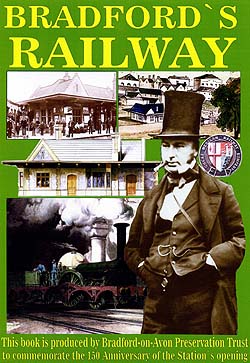
A new book has been specially produced by the Bradford on Avon Preservation
Trust covering the history of this remarkable Station and its buildings
which were designed by the great victorian engineer
- Isambard Kingdom Brunel.
It is being launched on July 8th with a special Exhibtion and will be
available at local book shops and the Station or can be ordered online
here at £3.99.
|
 |
|
|
or
sales@freshford.com
click here for a copy of the poster for the forthcoming exhibition
|
|
|
|
If you wish to know more about our Railway Station and its history there
follows an extract from the new book - Bradford`s Railway which is available
at just £2.99 locally or £3.99 including postage/packing on
our web site.
If you click on most of the images you will be linked to larger versions.
There are also a number of PDF images.
|
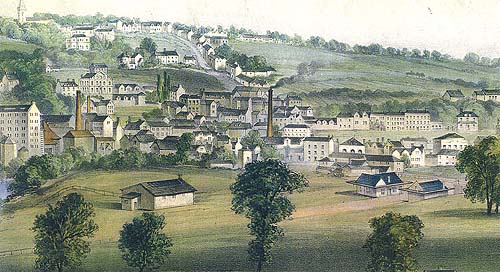 |
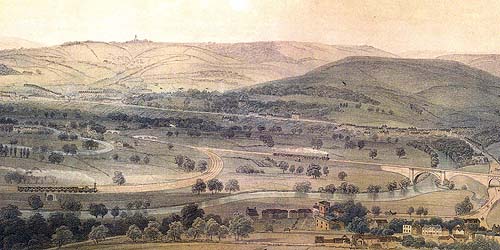
| The
view of the town showing the completed buildings, but without the track
as it was painted by Mrs E.Tackle in 1850. |
|
1830
|
The successful
opening of the Liverpool & Manchester railway led to widespread interest
in railways everywhere.
On 4th January 1830 a public meeting at the Assembly Rooms in Bath, convened
by a committee headed by Thomas Pycroft of Bath and John Harford of Bristol,
heard William Brunton outline his ideas for a railway between the two cities.
Brunton was a 52 years old Scots engineer whose chief claim to fame was
the invention of a steam engine with a pair of mechanical feet which helped
it to climb gradients. At a public demonstration it unfortunately exploded,
killing 13 people. Brunton stressed that "by judicious selection of
the line, and the arrangement made to the necessary embankments with arches
of stone masonry, the road will be nearly level throughout…" -
so no need for mechanical feet. Nothing further is heard of this proposal. |
|
1832
|
| The
much more ambitious idea of a railway between Bristol and London was put
forward by William Brunton and a fellow engineer, Henry Habberly Price,
in a circular dated 7th May 1832. The route proposed was from Bristol via
Bath, Bradford and Trowbridge to pass near Devizes and through the Pewsey
Vale to Hungerford, Newbury, Reading, Datchet, Colnbrook and Southall to
a site off Edgware Road in London. As far as Reading it would be following
the line of the Kennet & Avon Canal. Financial support was not forthcoming
so the scheme was dropped. |
|
1833
|
It
was lobbying from four Bristol businessmen, Thomas Guppy, John Harford,
William Harford and George Jones that preceded a meeting on 21st January
1833 between the Merchant Venturers, Bristol Corporation, the Bristol Dock
Company, The Chamber of Commerce and the Bristol & Gloucester Rail Road
Company to "take into consideration the formation of a Rail Road from
Bristol to London". They agreed to fund a survey of the route and deputed
Nicholas Rock of the Bristol Docks Committee to select an Engineer. Roch
had worked closely with Brunel on the improvements to the Bristol Docks,
but other engineers were also competing for the work: Brunton and Price,
who had promoted the 1832 scheme, and W.H. Townsend, responsible for the
Bristol and Gloucestershire Rail Road, a horse drawn tramway between Coalpit
Heath and Wharves on the River Avon. The committee selected the 27 year
old Brunel with Townsend as his assistant.John Harford of Blaise Castle
was a wealthy Banker and Merchant who had earlier backed Brunton`s scheme.
A preliminary survey was demanded in a month. Brunel, travelling on horse
back and lodging at country inns, surveyed the Brunton route through the
Vale of Pewsey and the Kennet valley, and a more northerly route via Swindon
and Wootton Basset. The latter gave the opportunity for branches to Oxford
and Gloucester; it was this that Brunel recommended, with an estimated cost
of £2,800,000. The project was formally launched at a meeting on 30th
July 1833 at Bristol Guildhall, where it was decided to form a company with
a board consisting of directors from Bristol and London. A prospectus was
issued in August 1833, naming 12 directors from each city and coining the
name "Great Western Railway". Shares were
priced at £5 and money was quick to come in. To construct a railway
and obtain powers for compulsory purchase of land it was necessary to obtain
an Act of Parliament. |
 |
|
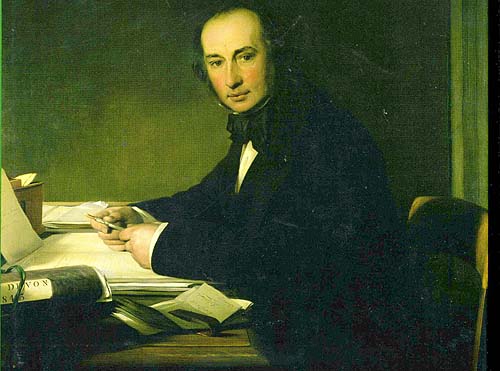
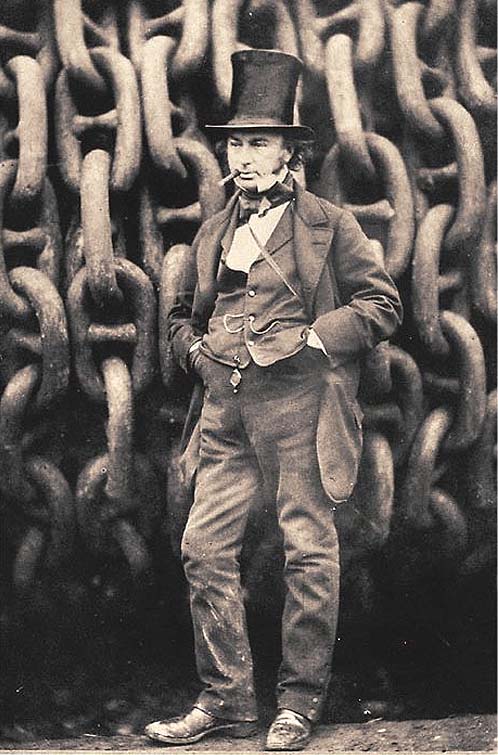
Isambard
Kingdom Brunel painted by his brother in law - John Callcott Horsley in
1857 .
|
|
1834
|
| The
board of the Great Western Railway Company presented a bill for the construction
of the railway. At the same time the London & Southampton Railway Company
presented their bill, which included a branch from Basingstoke to Devizes,
Trowbridge, Bradford and Bath, in direct competition with the G.W.R. Both
proposals were subjected to long examinations in committee before being
returned to the floor of the House of Commons. The London and Southampton
bill was approved by both Houses of Parliament, but without the branch to
Devizes, Bradford and Bath. The G.W.R. Bill was rejected by the House of
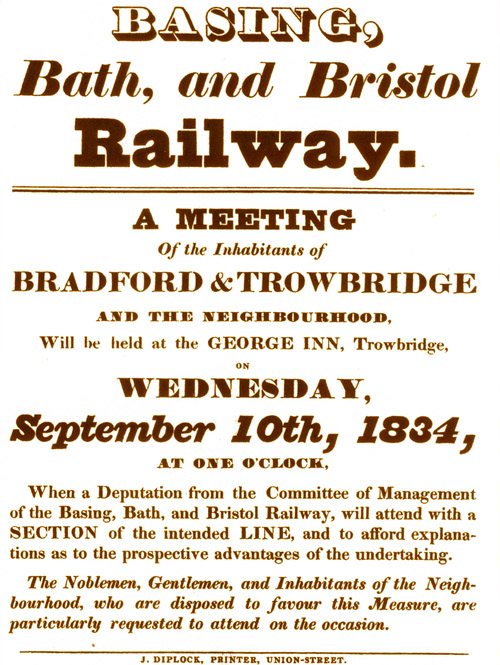
Lords. The GWR then issued a new prospectus in September 1834, the map showed
"probable branches" to Bradford and Trowbridge as well as to Gloucester
and Oxford. The cost of the main line was estimated at £2,500,000.
At the same time their rivals tried to raise support for a Basing, Bath,
and Bristol Railway - a revival of the branch of the London & Southampton
which had failed to win parliamentary approval |
 |
 |
|
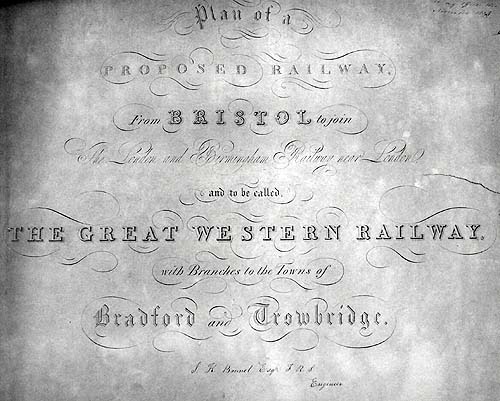
Frontispiece
to the early Plan for the Great Western including Bradford and Trowbridge
in 1834
|
 |
|
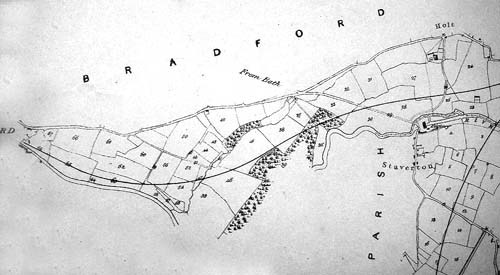
Map
showing original planned branch to Bradford on Avondated 1834, but never
proceeded with due to lack of funds.
|
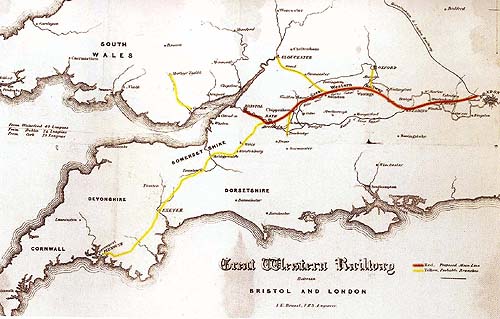 |
| A
Map of the Great Western Railway
from London to Bristol in 1834 |
|
1835
|
| In
February it was announced that capital of £2,000,000 had been raised.
A new bill was now presented to Parliament. Another long examination in
committee followed, but this time the bill was passed by both Houses of
Parliament and received the Royal Assent on 31st August 1835. This included
powers to make a branch from Thingley Farm, near Chippenham to a "field
near the Gas Works in the part of the parish of Trowbridge called Islington,
with another branch thereout from the south- western extremity of Kingston
Farm adjoining the town of Bradford". |
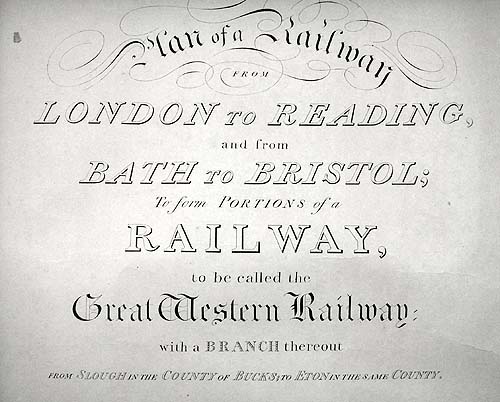 |
| Frontispiece
to the original Plan for the Great Western Railway from London to Reading
and then Bath to Bristol of 1834. |
|
1836
|
| Construction
started at the London and Bristol ends of the line. Brunel announced his
intention of using a broad gauge of 7ft 0 ¼ ins. For the track, instead
of the standard gauge of 4 ft 8 ½ ins in use on the London &
Birmingham and other railways, to a meeting of the Directors on 15th September
1835. |
|
1837
|
It had
always been part of Brunel`s vision that his railway would be part of a
route from London to New York. A Great Western Steamship Company had been
formed in Bristol in 1836, with five of the same directors; Brunel offered
his services as designer. The vessel, "Great Western", was launched
on 19th July 1837; she made her maiden voyage on 8th April 1838 arriving
in New York fifteen days later.
|
|
1838
|
With completion
of the railway from London to Maidenhead, a regular passenger service was
started in June 1838.
|
 |
|
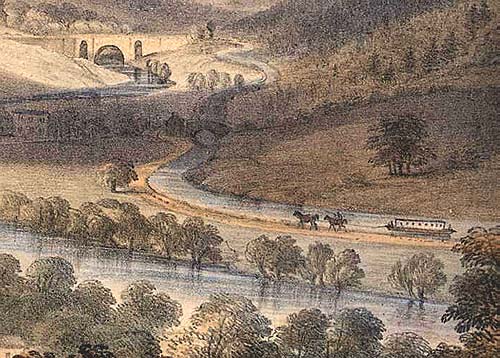
A
view showing a section of the Kennet and Avon Canal from Limpley Stoke
to Dundas Aqueduct, Claverton in 1850
|
1839
|
The London
to Southampton Railway was opened on 10th June 1839 and by 11th May the
following year had reached Winchester.
|
1840
|
The Bristol
to Bath line was opened on 31st August 1840.
1841
|
On the
30th June 1841 the line from London to Bristol and on to Bridgwater was
opened to traffic.
|
|
|
1843
|
| This year
saw the completion of Swindon locomotive works and soon the first GWR designed
engine, inevitably named "Great Western" |
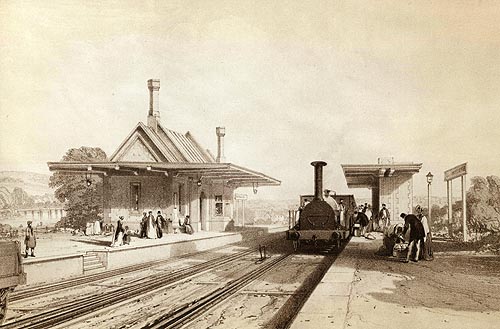 |
| Pangbourn
Station by Bourne. This Print gives an idea how Bradford would have originally
looked as the building and shelter are very similar to Brunel`s designs
for our station. |
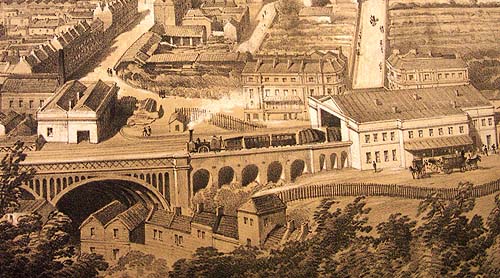 |
| A
View of Bath by Everitt with a Firefly locomotive emerging from the covered
station in 1846 |
 |
|
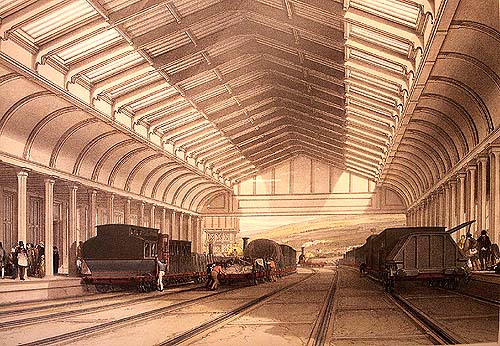
View
of Bath Station by Bourne in 1841. The roof covered all four tracks until
1897
|
|
1844
|
The
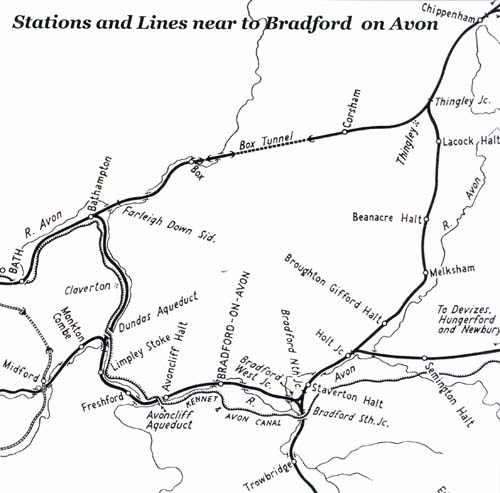
London and South Western Railway proposed a line from Basingstoke to Swindon,
in the heart of GWR territory. The GWR countered by promoting two nominally
independent companies to extend the broad gauge lines: the Berks & Hants
railway and the Wilts & Somerset Railway. The latter would run from
Thingley, just west of Chippenham, to Salisbury, with branches to Devizes,
Bradford and Frome, and a "coal branch" to the mines at Radstock.
At Salisbury the Wilts & Somerset was to connect with the London &
South Western's branch from Bishopstoke.
The first meeting of the Wilts & Somerset was held at the "Bath
Arms", Horningsham, near Longleat with Walter Long M.P. in the chair,
on 9th July 1844.
Plans for the line had been submitted by Isambard Kingdom Brunel. Charles
Alexander Saunders, Secretary of the G.W.R., attended the meeting and advised
on raising the capital (estimated by Brunel at £650,000) for which
the G.W.R. would be guarantor and offer a return of 3 ½% (later 4%)
on each share , being itself prepared to subscribe up to half the capital.
The G.W.R. was to have a perpetual lease and the right to work the line.
A month later it was agreed to extend the line from Frome to Yeovil, and
from Westbury to Weymouth, at an estimated cost of £350,000. At a
further meeting the name of the company was changed to the Wilts, Somerset
& Weymouth Railway. A bill was put forward and submitted to the recently
established Railway Department of the Board of Trade, which had taken on
the task of regulating the flood of new railway proposals. The Board of
Trade stipulated that a better line of communication must be provided between
the new railway and Bath and Bristol than by the junction at Thingley (though
the extra mileage over this route would have boosted the profits on goods
on the line). |
|
|
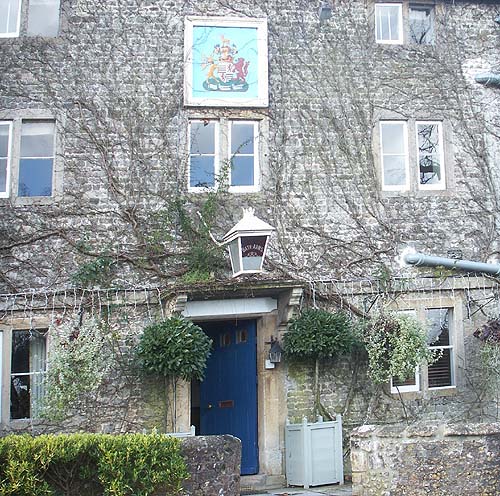
| The
Bath Arms at Horningsham, near Longlet, Warminster where onthe 9th July
1844 first meeting of Wilts & Somerset Railway was held with major land
owner-Walter Long as Chairman and I.K. Brunel as Company Engineer. This
decision was eventually to lead to the railway coming to Bradford on Avon.
|
|
1845
|
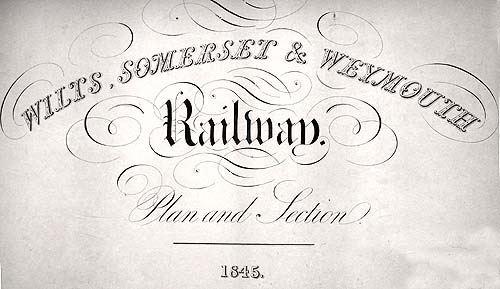
| The Wilts,
Somerset & Weymouth railway act received the Royal Assent on 30th June
1845. A condition was imposed that in the next session of Parliament the
company was to apply for an extension from Bradford to Bathampton (on the
GWR main line to Bath). Brunel warned of the expense of constructing this,
estimated at £150,000. By October 1845 the line from Thingley had
been staked out to Salisbury and almost to Bruton. |
 |
|
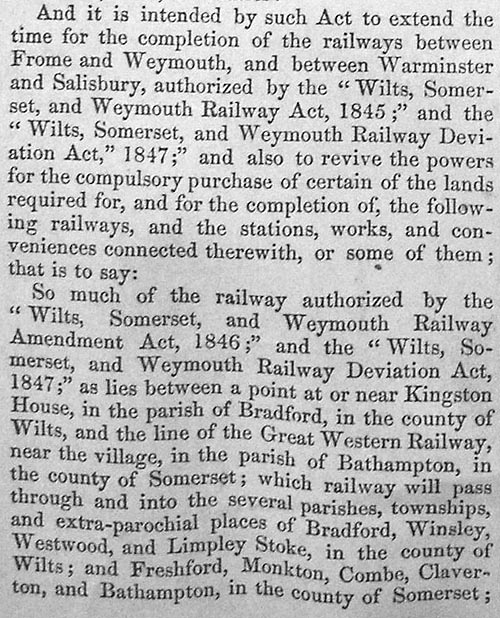
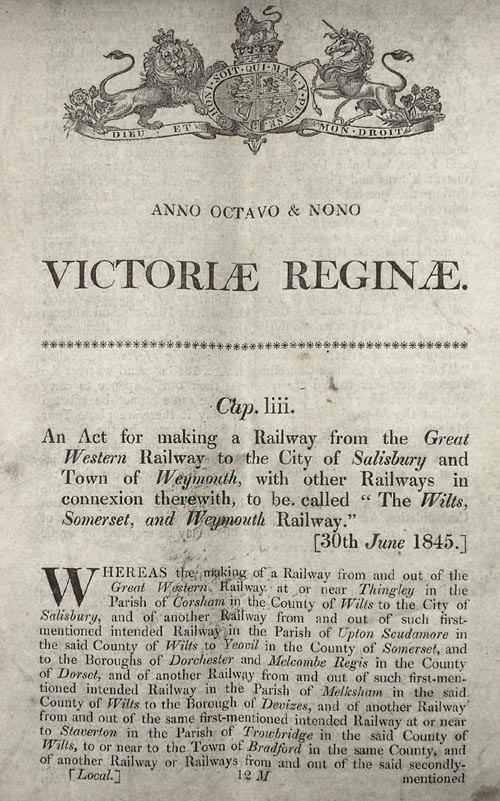
The
Act of 30th June 1845 detailing Bradford
|
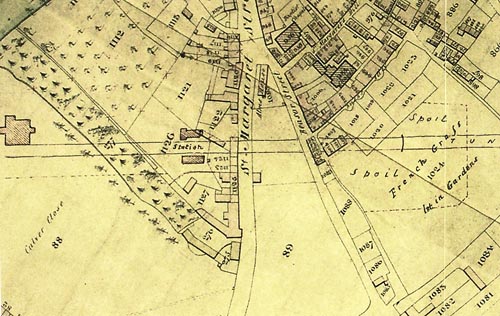 |
| Amap drawn
by George Ashmead in 1837 but later adapted to show the station buildings
and cuttings c.1850 before the track was to be laid for the opening in 1857.
The Spoil from the Tunnel is shown on French Grass. |
 |
|
|
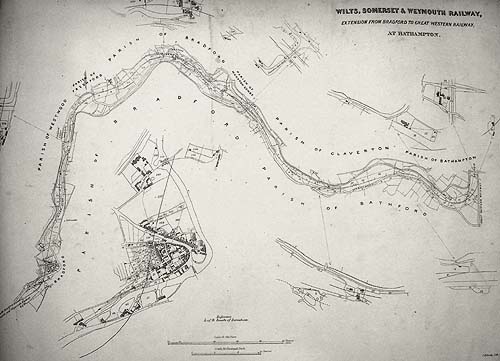
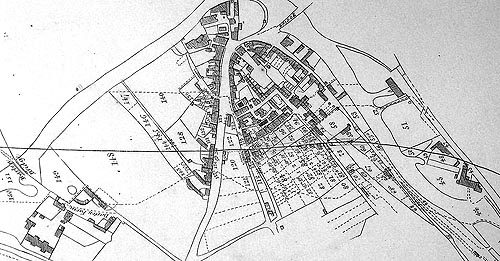
| An
interesting map of 1845 showing the propsed route of the railway line from
Bradford to Bathampton with inset maps of stations. |
 |
|
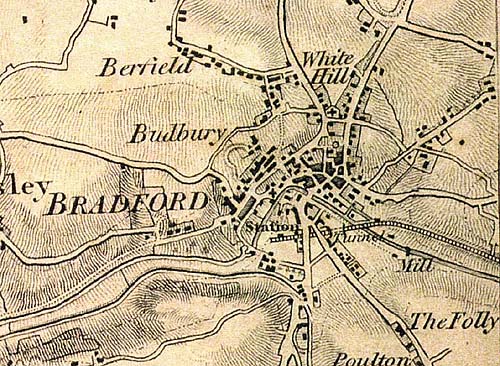
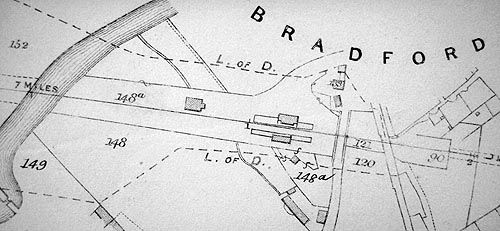
A close up of 1845 map showing Bradford section with proposed route for
railway. The numbers are from the detailed reference book which shows the
former owners and tenants before being purchased by the Wilts.Somerset &
Weymouth Railway Company |
|
1846
|
On 3rd
August 1846 an additional Act received Royal Assent authorising the construction
of a branch from Bradford to Bathampton, and an extension from Weymouth
to the Quay, besides other minor changes. Contracts were to be let from
Thingley to Staverton, Staverton to Heytesbury and Heytesbury to Salisbury.
The directors required that the contractors were to co-operate in preventing
Sunday working where it was not an actual and indispensable necessity.
The rush of new railway projects made it difficult to find firms to take
on the work, but in February 1846 the contractor had erected workshops at
Melksham and was "to break ground immediately". By August the
Melksham and Trowbridge contracts were in full operation. Brunel reported
to the Directors that in October a start would be made on laying the permanent
way from Thingley to Bradford.
The "railway mania" of the 1840s led to greater demands for capital
than the market could raise. It rose from about £4 ½ million
for 1842 to £60 million in 1845 and £132 million in 1846, triggering
the financial crisis that broke the WS&WR. |
|
1847
|
On 29
January 1847 Messrs. Tredwell, the contractors, started work on the Bathampton
branch. Later that year there was an incident when some navvies brawled
at Bathampton.
John Bailey, a constable not in uniform, announced his status and ordered
them to stop rioting. They replied by hitting him so hard that he later
died of his injuries. Maurice Perry was the only navvy to be recognised
and arrested and was later sentenced to death. The major engineering works
on the line from Thingley to Westbury were undertaken. There was a complaint
that work had proceeded on Sunday 21st march 1847 despite the rule against
Sunday working. This had been at Ladydown, where water had to be run into
a temporary channel to keep the Kennet & Avon canal open while the railway
was tunnelled underneath it. More difficulties were found at Avoncliff where
the banks of the canal were found to be insecure. A temporary aqueduct was
built of timber prior to the railway tunnels and the restoration of the
canal, but traffic on the canal was interrupted and a fine had to be paid. |
|
1848
|
Work continued,
but at a slower pace. Nevertheless the bridges over the River Avon near
Bradford Great Wood and below Greenland Weir were built as was the tunnel
under St. Margaret's Hill and the bridges carrying the Frome and Trowbridge
roads over the railway. So, too, were the station buildings and goods shed.
On the main line the rails were laid to Westbury and that section opened
in September 1848. On Saturday 2nd September a special train driven by Mr
Gooch, the locomotive department superintendent, assisted by Mr Brunel,
drove a train of directors and special guests from Chippenham through Melksham
and Trowbridge to Westbury. Crowds greeted the train: at Melksham the band
played; at Trowbridge a cannon was fired, at Westbury the Mayor presented
an address. |
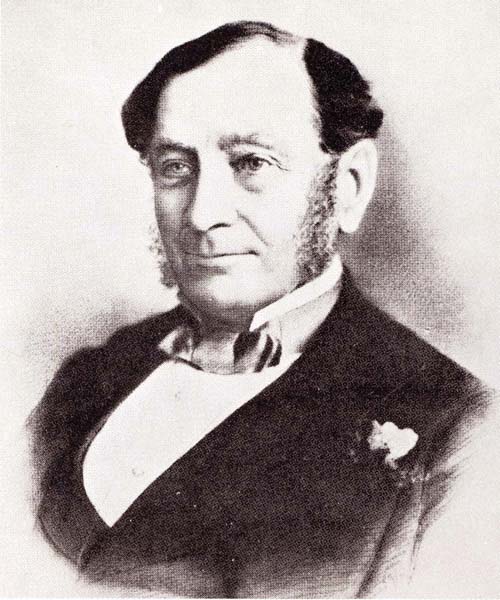 |
| Sir
Daniel Gooch was appointed by Isambard Kingdom Brunel as locomotive superintendent
of the Great Western Railway at the age of twenty-one. He designed the finest
locomotives of the period and in 1865 became Chairman of the G.W.R. and
rescued it from bankruptcy. |
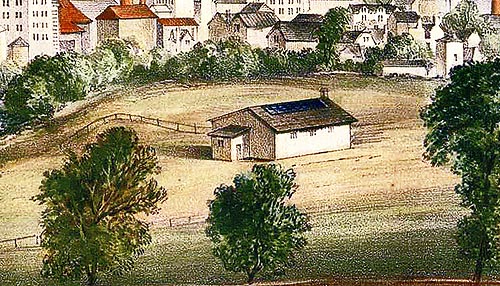 |
|
The
Goods Shed at Bradford on Avon in 1850 waiting for tracks
|
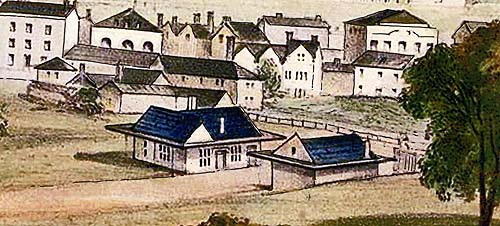 |
|
Bradford
on Avon Station in 1850,seven years before the opening showing all the
buildings completed.
|
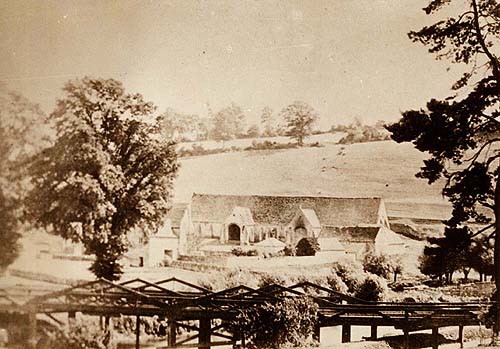 |
| In
the foreground of this old photograph looking down on to Barton Farm is
the original wooden bridge which carried the railway over the Avon wets
of the station.A box girder bridge replaced the wooden bridge in 1872 and
itself was replaced in 1960 with the present bridge. |
|
1849
|
At the
half- yearly meeting of the WSWR on 26th February 1849 the shareholders
were told that because of the financial depression the only work in progress
was that already under contract. Rails were being laid on the Bradford Branch,
and work would concentrate on the Westbury- Frome line.
On 4th June 1849 the G.W.R. Secretary wrote to the WSWR Directors saying
it was the "strong and decided opinion" of his directors that
all works should be stopped except those from Westbury to Frome. In October
1849 the WSWR directors resolved "that it is highly desirable that
the railway should be sold to the Great Western Railway Company upon such
terms as will produce to the shareholders in this company, the same rate
of interest .. as is provided for them under the agreements between the
two companies that was signed on 31st December 1849"; this gave the
paid up shareholders a return of 4% on their investment. |
|
1850
|
On 14th
march 1850 the WSWR was transferred to the GWR, though the Act of Parliament
abolishing the WSWR was not passed until 3rd July 1851.
On 7th October 1850 the line from Westbury to Frome was opened. But on taking
over the
WSWR the GWR had announced its intention of abandoning the Bradford branch.
There was widespread dissatisfaction, as also among people in Devizes, work
on whose branch was now suspended. |
|
|
|
A
map of Bradford on Avon c.1850 showing the incomplete railway line
|
|
1852
|
On 30th
June 1852 the Great Western Railway Act No. 1 gave a legal confirmation
of the sale of the Kennet & Avon Canal to the GWR, which had effectively
destroyed its trade.
A coalition of local interest brought an action against the GWR to compel
them to complete the lines for which the Wilts Somerset & Weymouth Railway
had possessed powers. It was heard at Somerset Assizes in the Michaelmas
Term of 1852; the lawsuit was defeated, except for the Bradford to Bathampton
branch. |
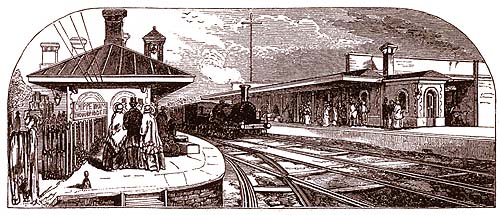 |
|
Chippenham
Station in 1852
|
 |
|
1853
|
| The
GWR appealed against the judgment that it should complete the Bathampton
branch, but this was rejected on 23rd April 1853. A mandamus had been issued
commanding the GWR to complete the branch, to which the company protested
that its powers to acquire land had expired. This Bail Court refused to
accept this; it was contended that the GWR could acquire the land by agreement
with the landowners. A peremptory mandamus was awarded by the court.
|
|
|
|
An
abstract from the Act of 1854 dealing with the extension from Bradford
to Bathampton
|
|
1854
|
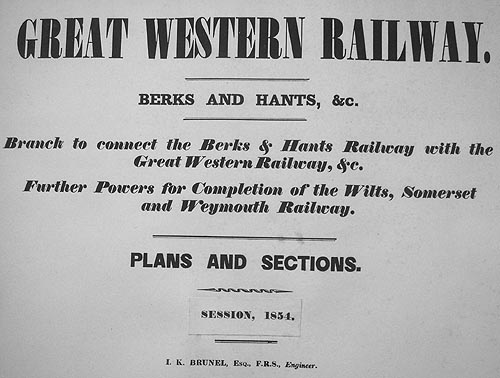
A new
Act of Parliament received the Royal Assent on 31st July 1854 granted an
extension of time for the completion of the Wilts, Somerset & Weymouth
Railway, but stipulating that if it was not complete within the three years
it would be unlawful for the GWR to pay a dividend on ordinary capital until
the line was completed and opened.
Powers were granted to raise an additional £1,000,000 in capital.
Negotiations were re-opened with land owners along the route, a timber bridge
built over the Avon at Barton Farm and other engineering work re-started.
|
 |
|
1855
|
Work continued,
it was only in this year that John William Yerbury sold land at Belcombe
Court for the building of the railway. The agreement included the provision
of a decorative underpass for access to the river and the planting of trees
beside the line to screen it from the house.
|
 |
|
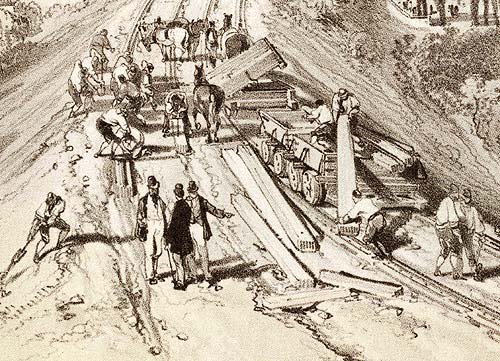
This
print by Bourne shows track laying along the Great Western railway line
near Bath.
|
|
|
|
The
proposed Plan of the Railway layout updated by the Great Western Railway
in 1854
|
|
1856
|
In January
1856 the G.W.R. applied for an extension of time. On 17th January Colonel
Wynne made an inspection on behalf of the Board of Trade and believed another
three to four months was required for completion. The main obstacle was
the tunnel under the Kennet & Avon Canal at Dundas. It was reported
that it had to be cut through material of a treacherous nature and the side
walls were built in lengths not exceeding 10 ft., each section in a pit
whose sides had to be closely shored all round. The requirement was that
the canal must be kept open for traffic and so could not be drained.
On 21st July 1856 the "Wiltshire Times" reported the fall of a
wall near the line of the railway, killing one workman and so injuring another
that he was not expected to live. |
|
|
| This engraving
shows the spur at Bathampton for the line that went on to Bradford and was
painted by Bradford artist- Mrs Elizabeth Tackle c.1850. |
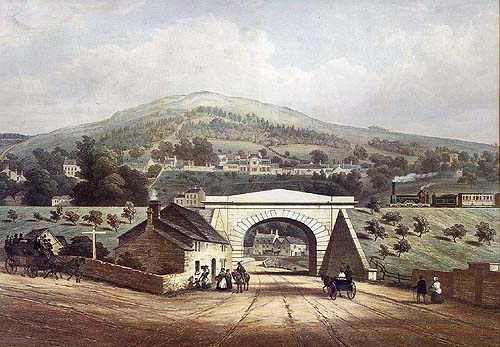 |
| This view
again by Mrs Elizabeth Tackle shows the Viaduct at Bathford c.1850, with
the Crown Inn in the distance. She reveals the end of an era with the Firefly
locomtive speedily travelling above the older mode of transport the stage
coach. The vantage point is now the roundabout and the cottages at the bottom
have long since been demolished.The bridge was built by Isambard Kingdom
Brunel with the Great Western Railway, and completed in 1841. |
|
1857
|
On 16th
January 1857 Colonel Yolland inspected the completed line between Bradford
and Bathampton. He found that the permanent way had only just been laid
and was very rough. The station buildings and signalling were incomplete
and he said it was not fit for opening to passenger traffic. After re-inspection
a fortnight later, he granted a certificate. On 2nd February 1857 the line
finally opened. The "Wiltshire Times" reported (on 7th Feb. 1857):
On Monday last the line between Trowbridge and Bath via Bradford was opened
for traffic The first train arrived here soon after 7.00 am and 10 trains
are registered to run, viz 5 up and 5 down. Considerable excitement prevailed
throughout the day, on the arrival of each train the railway station was
besieged by hundreds of eager spectators. The celebrated Bradford brass
band played lively airs at intervals during the day, and as often as might
be heard the sound of the merry church bells. A good dinner was provided
in the evening by Mr J,C. Neale of the Swan Hotel. We learn that the inhabitants
of the town are not contented with the list of fares laid down by railway
company; for a return ticket from Bradford to Bath a distance of 9 miles,
a fare of 3/3d is demanded, whereas from Trowbridge to Frome, a similar
distance, the price is only 1/6d. The line curves away from the main about
on mile from Trowbridge station through Bradford, Avoncliff, Freshford,
Limpley Stoke to the junction at Bathampton where it joins the GWR to Bath
etc., passing 3 times under the Kennet and Avon Canal and 6 bridges by extensive
viaducts over the river Avon. |
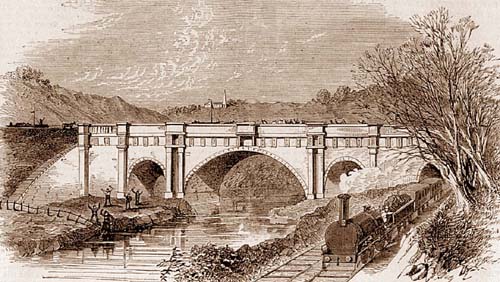 |
| An
engraving produced for the Illustrated Home a few days after the opening
of this branch of the railway on February 2nd 1857. In the background is
the Dundas Aqueduct at Claverton with enthusiatic spectators watching the
Firefly speeding past on its way to Bath. |
 |
 |
|
A
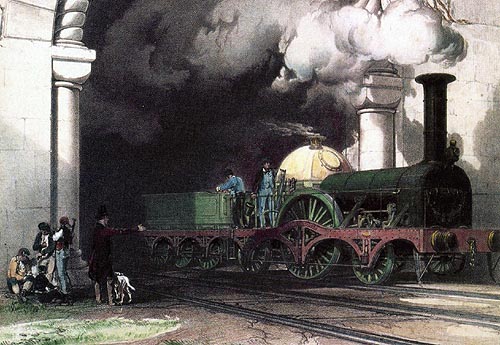
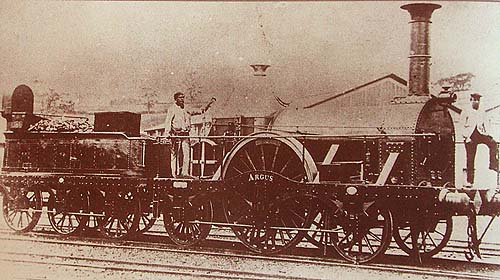
Firefly Locomotive,designed by Daniel Gooch were amongst the first locomotives
to be seen on the Bradford line.
|
Again
on June 27 1857 The Wiltshire Times reports:
Bradford.
On Monday 22nd this unusually quiet town was greatly enlivened by an excursion
train which stopped at the Bradford station on its way to Weymouth. Here
it was joined by the brass band belonging to the town, to whom great credit
is due to for the very praiseworthy way in which they enlivened the pleasure
of the day. The weather was remarkably favourable but a goodly number of
passengers (150-200) found difficulty in obtaining seats and it would have
been easier if rail carriages had been awaiting the train, and it would
have been given greater satisfaction.
Another Wiltshire Times news item reports that:
On July 25 1857 Excursion Train
Yesterday morning a monster train from Bristol, Bath and Bradford passed
our station on its way to Salisbury. It consisted of about 30 carriages,
propelled with two powerful engines. The train was a very heavy one and
must have conveyed about 2,000 persons. Our
neighbours at Bradford a short time ago expressed themselves to be annoyed
with the accommodation they received on an excursion to Weymouth, on this
occasion they have been preferred. However, many persons from Trowbridge
we believe availed them selves of the privilege by obtaining tickets at
Bradford. |
The
initial service of five trains per day each way was not generous, but no
doubt adequate for the available traffic. In any case, the long stretches
of single track, coupled to the heavy gradients on the southern section,
made anything more ambitious impossible. After waiting seven years the people
of Bradford were offered a free excursion train to Weymouth. In the same
year the 8-mile branch from Holt Junction to Devizes was opened on 1st July.
The whole route from Bradford junctions to Bathampton was constructed for
a double track but from Barton Farm in Bradford to Bathampton only a single
track was laid. It seems irrational after all the effort to drive double
tunnels under the Kennet & Avon Canal.
From Bradford Junctions, where the branch leaves the Chippenham to Trowbridge
line to Bradford, the double track consisted of Brunel`s original design
of rails laid on continued baulks of timber, with transverse wood transoms
at intervals. From Bradford to Bathampton the rails were laid on cross sleepers,
similar to today's track except that the sleepers were spaced at 3 ft intervals. |
 |
|
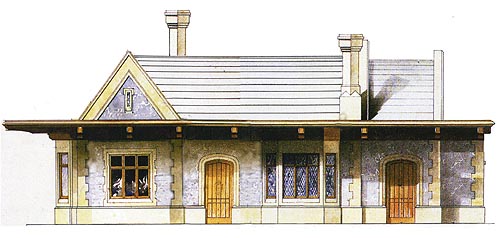
A
composite view of the Station at Bradford on Avon using Brunel`s drawings
for a Wayside Station in 1843.
|
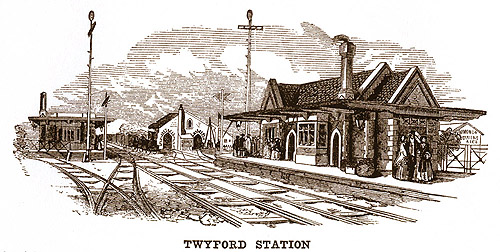 |
| This
station is almost identical to that of Bradford on Avon with its Jacobean
design by Brunel. It gives one an impression of how our station would have
looked at its opening with its Goods Shed in the background and Shelter
on the opposite platform |
|
| |
| Besides
his work on cuttings, embankments, tunnels, bridges, track, signalling,
locomotives and all details of railway design, Brunel also produced standard
designs for stations. For Bradford the design for Twyford Station (on the
G.WR. main line between Maidenhead and Reading) was re-used, but built entirely
of local Bath stone, rather than in brick and stone. It is characterised
by a steep gabled roof, flat canopies or awnings on cantilever beams and
brackets, doorways with flat Tudor arches, and the tall, diagonal chimneys
which were a trade mark of Brunel`s stations. |
This
design was the most elaborate of Brunel`s five standard designs for "roadside"
stations. At Culham, Oxfordshire, there is a simpler but very similar type,
the only survivor of many more, most of those on the main line have been
destroyed when the track was quadrupled in the 1870`s.
The style is similar to the Elizabethan/Jacobean style used by architects
like Edward Blore and Anthony Salvin for many of their country houses of
this period. Apart from the canopies, the stations could easily serve as
lodges or estate houses to one of these grand country estates.
From Brunel`s sketches, the detailed plans were drawn up by his assistants.
The names of J. Geddes, I. Nolloth and F. Prinsit have been recorded as
assistants in 1848, but it is not known which worked on Bradford. Geddes
and Nolloth were responsible for the station at Melksham, with a somewhat
similar design to Bradford |
 |
|
|
1859
|
| The
death of Brunel in 1859 shocked the Great Western severely. His creative
genius saw most of his work completely fulfilled except for the problems
with the ship 'Great Eastern' and the Clifton Suspension bridge which would
be finished in 1864 after 30 years construction. It was on the 'Great Eastern'
that Brunel suffered a heart attack and died on the 15th of September. He
was buried at Kensal Green cemetery in London, not far from his own Paddington
station |
| 1861 |
The Weymouth,
Portland & Dorchester Telegram of 1 August 1861 reports that:
"The facilities afforded by this company (GWR) for trips to this favourite
watering place have induced thousands to avail themselves of the facilities
offered. On Monday last an excursion train of 22 carriages containing 850
passengers arrived from Bath and Bristol."
Later on the 29 August it wrote:
"For the last few weeks, the excursion trains have brought into the
town several thousands of visitors and although their stay in many cases
is of very short duration, the lodging houses are pretty nearly always full."
Many of these travellers would pass through Bradford on their way to Weymouth.
The railway gave cheap, speedy travel and Weymouth boomed with this new
trade. |
| 1870 |
| The G.W.R.
made an agreement with the coal mine proprietors of the Somerset coalfield
that the Bristol & North Somerset Railway (which was helped by G.W.R.
and opened in 1873) was to provide a standard gauge line between Radstock
and Salisbury. |
| 1871 |
| Charles
Keslingbury shown as Station Master in the Census for that year living in
the Station Master's House at the corner of St. Margaret's Street and the
Station Approach. |
|
|
| 1872 |
| The GWR
obtained an Act of Parliament for the construction of the Severn Tunnel,
which would provide a direct link between the South Wales coalfields and
the South of England. |
|
|
|
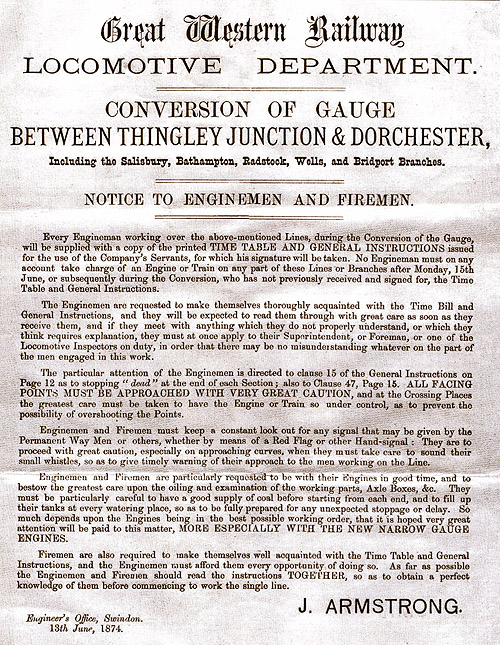
Notice
concerning the Conversion from Broad Guage to Standard in 1874
|
|
1874
|
| In
February 1874 the GWR`s directors announced that in view of the obligation
imposed by the agreement with the Somerset coal owners, that they were "of
opinion that the convenience of the public will be best met, and the interest
of the Proprietors best secured, by the alteration from Broad to Narrow
Gauge of all the lines in the district." The work was estimated to
cost £290,000 plus £70,000 for rolling stock (this would not
have included all coal wagons and other goods wagons, many of which were
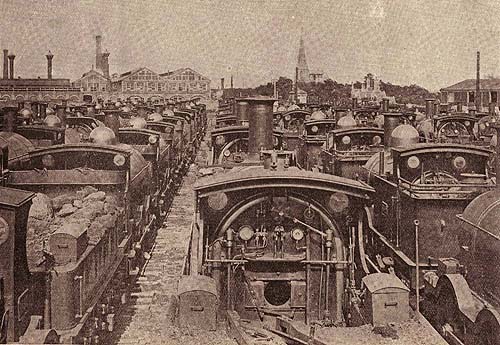
normally owned by the firms whose freight they carried). In just 5 days,
from 18th to 22nd June 1874, the entire length of the Bradford junction
to Bathampton line was converted to standard gauge, as well as the line
from Thingley Junction to Frome. |
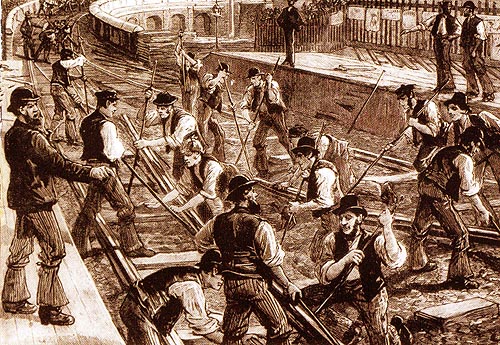 |
Conversion
from Broad Gauge to Standard in 1874
|
| The Up
line of the former and the Down line of the latter were converted first,
a reduced service being maintained on the other line. From Bradford to Bathampton
the single track was laid with cross-sleepers; additional chairs had already
been fixed to these, so the outside rail could easily be transformed into
the new chairs. The rest of the track was all laid on longitudinal timber
baulks. The transoms connecting these were marked ready for cutting; it
remained to saw them through and then shift the timber with its rail over
to its new position, fix it, and re-ballast the track. 1,800 men were employed,
many brought in from outside, mostly from the Oxford division on a special
train on 16th June. The workmen wore numbers and operated in parties of
|
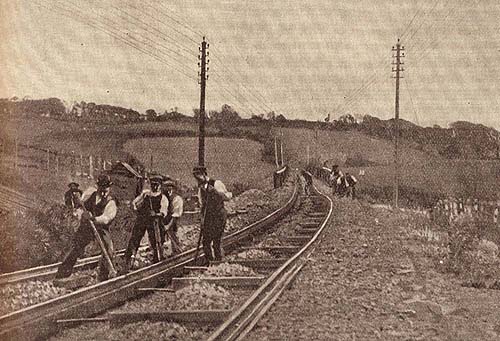 |
20
under a ganger who took charge of 1 to 1 ½ miles of track.
Work continued from dawn to dark, about 18 hours each day. The GWR provided
sheds for the men and straw to sleep on; smoking and drinking spirits were
forbidden. The workmen were paid off on 26th June, two special trains conveying
them back.
On 21st June nine long trains of standard gauge carriages were brought in
from Swindon. Normal services were resumed with the end of the Broad Gauge
era. |
 |
| |
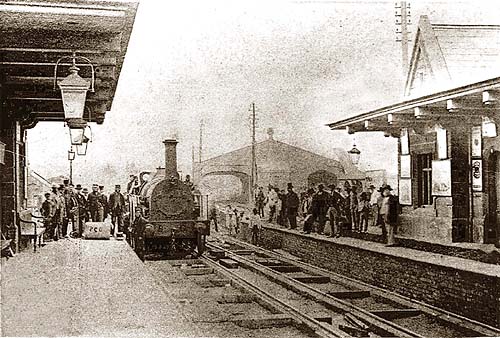 |
| The
historic event when between 18th and 22nd June 1874 the Broad gauge line
was converted to Standard gauge. on the left is a broad gauge train on its
line whilst parallel is the new standard gauge. The photograph now held
in the Trowbridge Museum could so easily have been Bradford as comparisons
with images of the station and the Goods Shed at this time are almost identical.
It is in fact Trowbridge before majopr alterations and shows what a gem
we have lost when caompared with the station today. |
|
|
|
|
| The
Severn Tunnel, which links England with Wales was completed in 1886 at a
cost of nearly £2, 000, 000. |
|
|
|
|
|